
A 1% move in a currency pair can feel small until leverage turns it into a meaningful gain or a fast loss. That is why one of the first questions serious traders ask is, what is forex leverage, and how does it actually affect a live position?
In simple terms, forex leverage lets you control a larger trade size with a smaller amount of your own capital. It is one of the core mechanics of Forex trading because currency markets often move in relatively small increments. Without leverage, many retail traders would need far more capital to make those price movements worth trading.
What is forex leverage?
Forex leverage is a tool that allows a broker to provide greater market exposure than the cash you deposit. If you have $1,000 in your account and use 1:100 leverage, you may be able to control a position worth up to $100,000, depending on the broker’s conditions and the instrument you trade.
That does not mean the broker is giving you free money. It means only a portion of the full trade value is required to open and maintain the position. That required portion is called margin.
Leverage is usually shown as a ratio, such as 1:10, 1:30, 1:100, or 1:500. The higher the ratio, the less capital you need to open a larger trade. This creates more buying power, but it also increases the speed at which profits and losses can accumulate.
How leverage works in real trading
The easiest way to understand leverage is to connect it to position size. Let us say you want to trade EUR/USD with a position size of 100,000 units, often called one standard lot. Without leverage, you would need the full notional value of that trade. With leverage, you only need the margin required to support it.
If the leverage is 1:100, the margin requirement is typically 1% of the total trade value. For a $100,000 position, that means you may need around $1,000 in margin. If the leverage is 1:50, you may need around $2,000. If the leverage is 1:10, you may need around $10,000.
This is where leverage becomes powerful. It allows traders to access the market with more efficiency and allocate capital across multiple positions instead of tying up the full value in a single trade. For active traders, that flexibility matters.
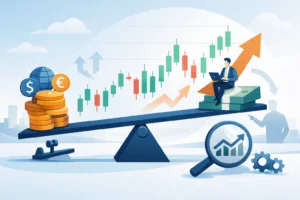
But the trade-off is direct. A small price move against a highly leveraged position can have an outsized effect on your account balance. Leverage amplifies exposure, not just opportunity.
Leverage and margin are connected
Many new traders treat leverage and margin as separate ideas, but they are two sides of the same mechanism.
Leverage describes how much exposure you can control relative to your deposit. Margin is the amount of account equity set aside to keep that leveraged position open. When you open a trade, part of your balance becomes used margin. The remaining funds in your account help absorb unrealized profit and loss.
If the market moves against you and your equity falls too far, you may receive a margin call or have positions automatically closed, depending on the broker’s margin policy. This is not a technical detail. It is one of the most important risk controls in leveraged trading.
That is why smart traders do not just ask how much leverage is available. They ask how much leverage makes sense for their strategy, account size, and risk tolerance.
Why leverage exists in Forex
Currency pairs usually do not move the way high-volatility stocks or crypto assets can move. In many cases, daily moves are measured in fractions of a percent. Leverage gives traders a way to make those moves meaningful without needing institutional-sized capital.
For example, if an unleveraged $1,000 position gains 1%, the profit is $10. With larger market exposure, the same underlying move has a bigger impact. That is why leverage is a standard feature in Forex and CFD trading.
Used with discipline, leverage can improve capital efficiency and support more advanced trade management. Used carelessly, it can reduce an account much faster than many beginners expect.
What is forex leverage in practice for beginners?
For beginners, leverage often looks attractive because it lowers the barrier to entry. You can open a relatively large position with a smaller deposit, which makes the market feel more accessible. That is true, but it can also create a false sense of control.
A trader with a $500 account using aggressive leverage may be able to open a position that looks exciting on the screen. The problem is that even a modest move against that trade can produce losses large enough to damage the account quickly. In other words, access is not the same as readiness.
A better approach is to think of leverage as available capacity, not a target to max out. Just because you can open a larger position does not mean you should. Precision matters more than size.
A simple example of leverage in action
Assume you have $1,000 in your account and use 1:100 leverage. You open a $50,000 EUR/USD position. A 1% move in the value of that position equals about $500.
If the market moves in your favor by 1%, that gain is significant relative to your account. If it moves against you by 1%, the loss is just as significant. The same leverage that can accelerate performance can also pressure your usable margin and trigger forced liquidation if risk is not controlled.
This is why leverage should always be viewed together with stop-loss placement, total exposure, and account preservation. Professional trading is not about using the maximum available power. It is about using the right amount at the right time.
Choosing a leverage level that fits your strategy
There is no single best leverage ratio for every trader. It depends on what you trade, how often you trade, and how you manage risk.
A short-term trader may want more flexibility because smaller intraday moves require efficient capital use. A swing trader holding positions longer may prefer lower effective leverage to leave more room for volatility. A beginner may benefit from a conservative approach while learning execution, position sizing, and discipline.
Higher leverage is not automatically more advanced. In many cases, experienced traders use it selectively rather than constantly. They understand that survival and consistency matter more than oversized exposure.
The risks traders underestimate
The biggest misunderstanding about leverage is that people focus on how much they can make and ignore how fast losses scale. That is the obvious risk, but it is not the only one.
Leverage can also distort decision-making. Traders may overtrade because larger positions create stronger emotional reactions. They may move stops, close winners too early, or hold losers too long because the numbers on the screen feel more intense. What starts as a technical setting can quickly become a psychological problem.
There is also the issue of market conditions. During high-impact news, spreads can widen, volatility can spike, and price can move faster than expected. In those moments, high leverage leaves less room for error. Execution speed and risk controls become even more important.
Using leverage with more control
A disciplined trader treats leverage as part of a broader risk framework. That means defining position size before entering the trade, using stop losses, monitoring margin level, and avoiding the habit of stacking too many correlated positions.
It also helps to use trading calculators and margin tools before execution. They make it easier to estimate exposure, required margin, and potential profit or loss under different scenarios. In a fast market, clarity is an advantage.
For traders building consistency, the goal is not to prove how much leverage they can handle. The goal is to stay in the market long enough to refine the strategy. That is where technology, execution quality, and practical education matter. At Alpin Markets, that is exactly how leveraged trading should be approached – with speed, precision, and clear risk awareness.
Final thought
Leverage is one of the features that makes Forex trading dynamic, capital-efficient, and accessible. It can sharpen opportunity, but it also demands respect. The traders who last are usually not the ones chasing the highest ratio. They are the ones who understand exposure, protect margin, and use leverage as a tool, not a shortcut.