
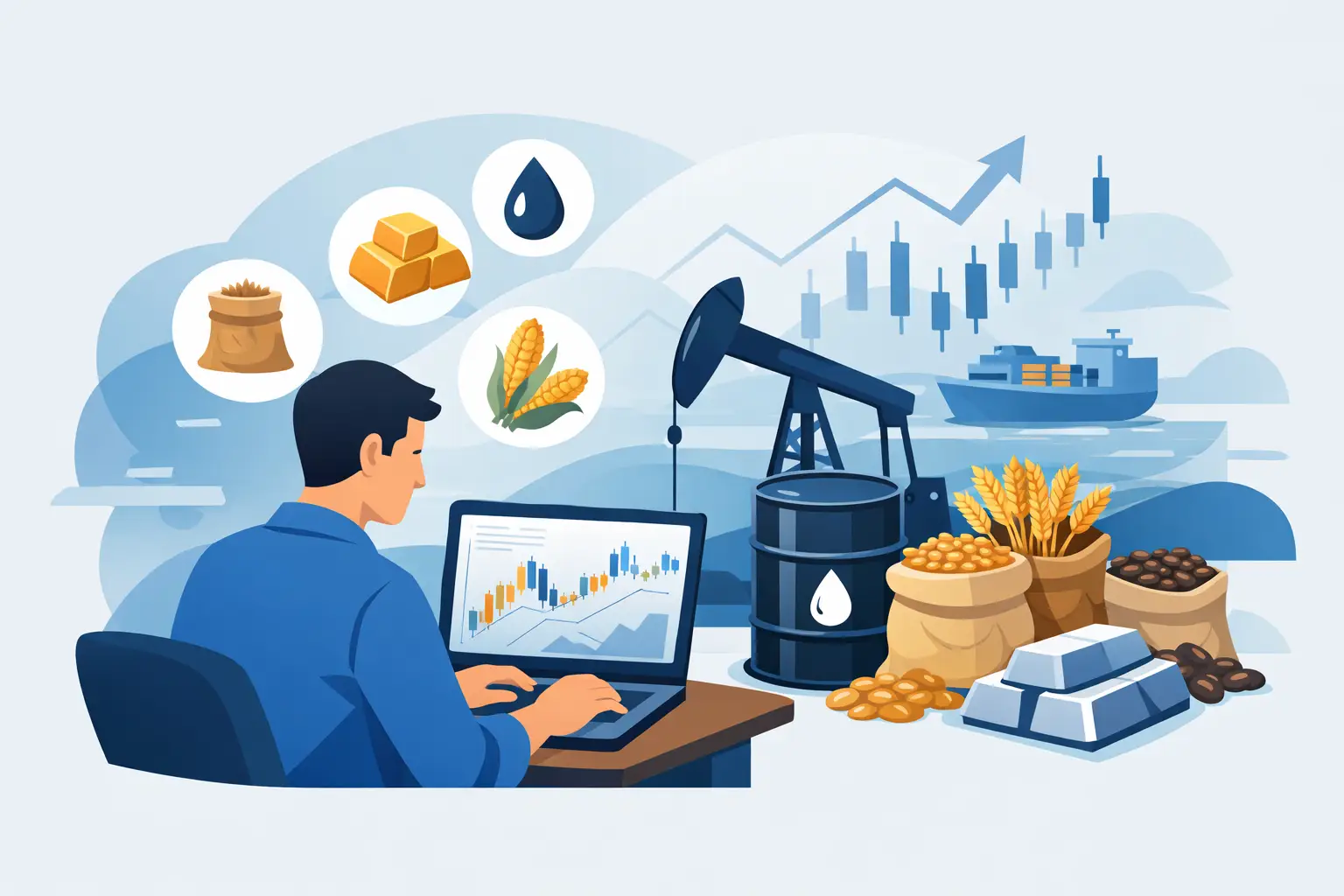
Commodity markets can move fast for reasons that have nothing to do with a company earnings report. A supply cut from major oil producers, a drought in a key agricultural region, or a surprise inflation print can shift prices in hours. If you want to learn how to trade commodities online, the real advantage is not just market access. It is understanding what moves these markets, how products are priced, and how to manage risk when volatility shows up.
What it means to trade commodities online
Trading commodities online means speculating on the price movement of raw materials such as gold, silver, crude oil, natural gas, coffee, wheat, or copper through an electronic trading platform. In many cases, retail traders do not buy physical barrels of oil or store metals in a warehouse. They trade price exposure through products such as CFDs or futures-based instruments.
That difference matters. When you trade a commodity online, you are usually focused on price direction, timing, position size, and margin requirements rather than physical delivery. For most self-directed traders, this makes the market more accessible and far more practical.
Commodities also behave differently from stocks and major currency pairs. They are often driven by macroeconomic forces, inventory data, weather patterns, geopolitics, transportation bottlenecks, and central bank expectations. Gold may react to real yields and risk sentiment. Oil may respond to production guidance, refinery demand, and conflict risk. Agricultural contracts can turn on rainfall and harvest expectations. The point is simple: commodity trading rewards traders who can connect price action with global events.
How to trade commodities online step by step
The cleanest way to approach commodity trading is to build from market access to execution, then from execution to risk control.
Choose the right market and product
Start by deciding what you actually want to trade. Metals such as gold and silver tend to attract traders looking for liquid instruments with strong macro sensitivity. Energy products like crude oil and natural gas can offer larger intraday moves, but that often comes with sharper risk. Agricultural commodities can be highly event-driven and less intuitive for newer traders.
Next, understand the product type available on your platform. Many retail traders use CFDs because they can speculate on rising and falling prices without owning the underlying asset. Others prefer futures-related exposure. What matters is that you understand contract specifications, trading hours, margin requirements, and how overnight holding costs or rollovers may apply.
Use a platform built for execution
A commodity trade is only as good as its execution. Fast-moving markets expose every weakness in a platform, from delayed pricing to poor order handling. You want a platform that gives you clean charting, dependable order entry, technical indicators, and enough depth to monitor price behavior with precision.
For many active traders, that means using a platform such as MetaTrader 5, where you can analyze multiple asset classes from one account, apply automated strategies, and monitor positions in real time. If you trade around scheduled events like inventory releases or inflation data, speed and reliability are not nice extras. They are part of the strategy.
Build a watchlist before placing trades
Many beginners jump straight into the most volatile commodity on the board. That usually ends badly. A better approach is to narrow your focus to two or three instruments and learn how they behave under different market conditions.
Watch how gold reacts to dollar strength, Treasury yields, and risk-off sentiment. Track crude oil around inventory data, OPEC headlines, and demand forecasts. Observe copper as a growth-sensitive commodity. When you follow fewer markets, you start to recognize patterns that random screen-hopping never reveals.
How to analyze commodity markets
If you want to know how to trade commodities online with consistency, you need both technical and fundamental context. Relying on only one side leaves blind spots.
Fundamental drivers matter more than many traders expect
Commodities are not priced in isolation. They sit inside a global chain of supply, demand, production, storage, shipping, and monetary conditions. Gold often trades as a defensive asset when recession fears rise or when inflation uncertainty increases. Oil can move on production quotas, sanctions, weather disruptions, and refinery capacity. Natural gas reacts strongly to seasonality and inventory expectations.
This does not mean you need to become an economist. It does mean you should know the major scheduled and unscheduled events that influence your market. If you are trading oil without knowing when inventory data is due, you are trading half-blind.
Technical analysis helps with timing
Fundamentals may explain why a market is moving, but technical analysis often helps with when to enter and where to place risk. Support and resistance, trend structure, moving averages, and volatility measures can all help frame a trade.
For example, gold may be bullish on macro conditions, but entering directly into resistance after an overextended rally is still poor execution. The better trade may come after a pullback, a consolidation breakout, or a retest of a key level. Strong traders do not confuse a good market idea with a good entry.
Risk management is the real edge
Commodity markets can trend cleanly, but they can also reverse hard. Leverage increases opportunity, and it increases exposure just as quickly. That is why risk management is not a side note. It is the operating system.
Start with position sizing. Decide how much account equity you are willing to risk on one trade before you think about profit. Many traders focus on the distance to their target and barely consider the distance to their stop. That is backwards.
Use stop-loss levels based on market structure, not emotion. A stop placed too close to current price in a volatile commodity will often get clipped by normal noise. A stop placed too far away without adjusting size can expose too much capital. There is always a trade-off between giving the market room and controlling downside.
It also helps to know when not to trade. If spreads widen sharply around major news, liquidity thins, or price action becomes disorderly, staying flat can be the best decision on the screen. Discipline protects capital just as much as a winning setup.
Common mistakes when trading commodities online
The first mistake is treating all commodities the same. Gold does not trade like natural gas, and wheat does not behave like Brent crude. Each market has its own rhythm, volatility profile, and event sensitivity.
The second mistake is overleveraging. A small account can still participate in commodity markets, but using maximum leverage because it is available is rarely a professional decision. Margin is a tool, not a target.
The third mistake is ignoring costs. Spread, swap, and execution quality all affect real performance over time. A trade idea can be correct and still underperform if the trading conditions are poor.
The fourth mistake is entering without a clear thesis. Buying because price is moving is not a strategy. You should know what you are trading, why now, where the trade is wrong, and what conditions would justify staying in the position.
Choosing a broker for commodity trading
Broker selection shapes more than convenience. It affects pricing, execution, platform tools, and trust. If you are serious about learning how to trade commodities online, look for regulation, transparent fees, strong platform infrastructure, and access to multiple markets from one account.
This is especially relevant if you want to combine commodities with forex, indices, or crypto in the same workflow. Market opportunities rarely appear on a single chart. A trader tracking gold may also want to monitor the dollar index, equity sentiment, and rate expectations. A multi-asset setup makes that far easier.
Alpin Markets fits this model by giving traders access to commodities alongside other global markets through MT5, with transparent pricing, professional-grade execution, and the regulatory structure serious traders expect. For newer traders, the low entry point matters. For experienced traders, speed, tools, and account efficiency matter more. The best setup can serve both without feeling watered down.
A practical way to start
Begin small. Pick one metal and one energy market. Trade them on a demo or with minimal size until you understand their reactions to news, technical levels, and session timing. Keep a simple journal. Write down the setup, the reason for entry, the risk level, and whether the outcome matched the thesis.
That process sounds basic, but it builds the habits that separate impulsive trading from repeatable decision-making. Over time, you stop chasing movement and start recognizing conditions.
Commodity trading online is attractive because the markets are global, liquid, and often full of opportunity. But access alone is never the edge. The edge comes from preparation, execution quality, and the discipline to protect capital when the market stops doing what you expected. Start there, and the screen begins to look a lot less random.