
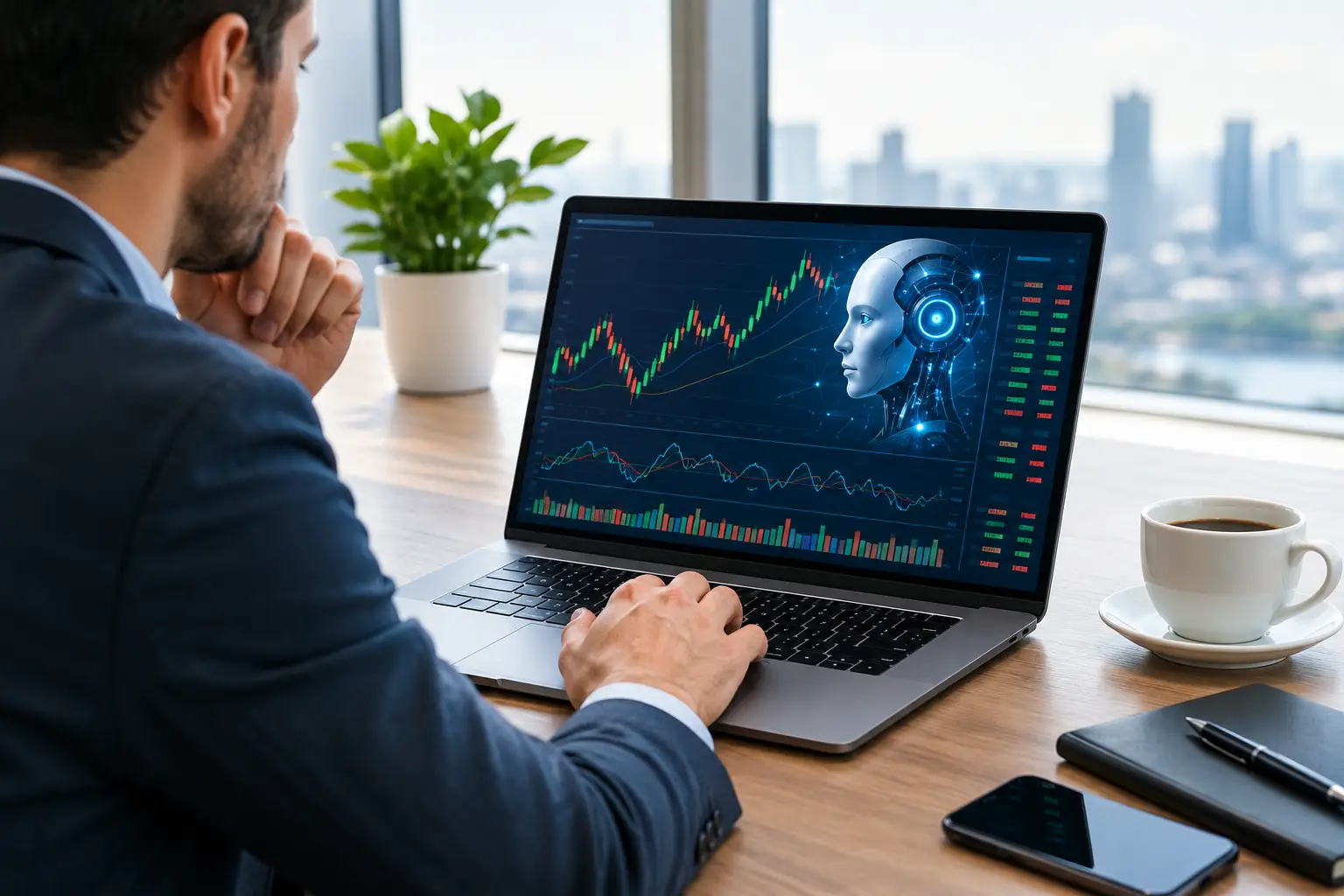
A currency pair can move sharply in seconds after an inflation release, central bank comment, or unexpected shift in risk sentiment. No trader can read every headline, monitor every timeframe, and calculate every position scenario at once. That is where AI in forex trading has real value: not as a prediction machine, but as a faster way to process information, identify patterns, and enforce a disciplined process.
The distinction matters. Forex markets are deep, liquid, and influenced by economic data, interest-rate expectations, capital flows, and market positioning. AI can help traders work through those inputs at speed. It cannot remove uncertainty, guarantee a profitable trade, or replace sound risk management.
What AI in Forex Trading Actually Means
AI is often used as a catch-all term, but traders should separate the technology from the marketing. In practical forex trading, AI usually refers to systems that analyze large sets of market data, recognize relationships within that data, and generate an output such as a probability, alert, trade signal, or execution decision.
Some tools use machine learning to identify recurring price behavior. Others apply natural language processing to assess whether news coverage or central bank communication is becoming more hawkish or dovish. More advanced systems can combine price action, volatility, order flow proxies, economic calendars, and sentiment data into a single model.
A conventional automated strategy follows explicit rules: buy EUR/USD when a moving average crosses above another moving average, for example. An AI-driven model may instead assess hundreds of inputs and estimate whether a bullish move has a higher-than-normal probability of continuing. The advantage is flexibility. The trade-off is that the logic may be harder to interpret and validate.
That makes transparency a key consideration. If you cannot explain what a system is designed to detect, when it should stay inactive, and how much it can lose, you should not allow it to control meaningful capital.
Where AI Can Give Forex Traders an Edge
The strongest use cases are often operational rather than dramatic. AI is especially effective when a trader needs to filter noise, react consistently, or review more information than they could reasonably process by hand.
Pattern recognition across markets
Currencies do not trade in isolation. USD/JPY may react to Treasury yields, gold can reflect shifts in real-rate expectations, and commodity-linked currencies can move with energy or industrial metals. An AI model can monitor these relationships continuously and flag when correlations are strengthening, weakening, or moving outside normal ranges.
This does not mean correlation equals causation. It means the trader has a better prompt to investigate. If AUD/USD is rising while iron ore prices, Chinese growth data, and broad risk appetite are all weakening, the move may deserve closer scrutiny before a position is opened.
Faster news and sentiment analysis
The first market reaction to a headline is not always the final reaction. AI tools can scan central bank statements, speeches, and financial news far faster than a human reader. They may classify language as more restrictive, more supportive of growth, or broadly neutral compared with prior communication.
For active traders, that can improve preparation around events such as Federal Reserve decisions, nonfarm payrolls, CPI, and rate announcements. But the final trade still depends on context. A hawkish statement may support a currency unless the market had already priced in an even more hawkish outcome.
Smarter execution and trade management
Execution quality is a trading variable, particularly for short-term strategies. Algorithms can help determine when liquidity is thinner, when spreads are widening, or when a large order may need to be broken into smaller parts. They can also automate practical actions such as placing stop-loss and take-profit orders, reducing exposure before a major event, or preventing new positions once a daily loss limit is reached.
For traders using MetaTrader 5, algorithmic tools can support alerts, rule-based execution, and systematic strategy testing within a professional trading environment. The technology is most useful when it serves a clearly defined trading plan rather than creating one after the fact.
Better trade reviews
Many traders keep a journal but never extract the lessons buried in it. AI can organize a history of trades and identify patterns: perhaps losses increase after the third trade of a session, winning setups perform poorly during low-liquidity hours, or position sizes become too large after a prior win.
This is one of the most practical applications because it turns trading data into behavioral feedback. The market may not become more predictable, but your own decision-making can become more consistent.
The Limits That Matter Most
AI models learn from historical data. Forex markets change. Interest-rate cycles turn, central bank priorities shift, liquidity conditions evolve, and geopolitical shocks can make previous relationships unreliable. A model trained during a low-volatility period may fail when volatility expands.
Overfitting is another major risk. A strategy can look exceptional in backtesting because it has been tuned to historical noise rather than a repeatable market behavior. If a model requires dozens of precise settings to perform well, it may be fragile. Out-of-sample testing, realistic spread assumptions, slippage, commissions, and a meaningful sample of live or forward-tested results are essential.
There is also a human risk: automation can create false confidence. A polished dashboard, a high win rate, or a stream of precise-looking signals can make a weak system appear credible. Win rate alone tells you very little without average profit, average loss, drawdown, risk per trade, and the conditions under which the strategy fails.
No AI tool can reliably forecast every price move. Any service promising guaranteed returns, near-perfect accuracy, or risk-free automated trading should be treated as a warning sign, not an opportunity.
How to Use AI Without Handing Over Control
Start with one defined problem. You may want to screen for high-volatility pairs, summarize central bank language, identify chart setups, or enforce position-sizing rules. A narrow objective is easier to test than an all-in-one system that claims to trade every market condition.
Next, establish the risk rules before evaluating performance. Decide the maximum risk per trade, the maximum daily or weekly loss, the largest permitted drawdown, and the conditions that require the system to pause. Those limits should remain in place even when the model has a strong recent record.
Then test in stages. Review historical results, but do not stop there. Use a demo environment or the smallest practical size to see how the strategy behaves with live spreads, changing liquidity, and real-time news. Compare the actual results with the backtest rather than assuming the two will match.
Finally, maintain human oversight. Check whether the model is trading during expected market conditions, whether its assumptions still hold, and whether execution remains aligned with your plan. A system that cannot be monitored cannot be responsibly scaled.
Choosing an AI Tool for Your Trading Style
The right tool depends on how you trade. A swing trader may get more value from macro sentiment analysis and economic-event filtering. A day trader may prioritize volatility alerts, execution rules, and real-time market monitoring. A systematic trader may need clean historical data, backtesting controls, and the ability to integrate custom algorithms.
Focus on evidence, not claims. A credible provider should explain the data used, the timeframe tested, the risk assumptions, and the strategy's weak periods. It should be clear whether signals are fully automated, discretionary suggestions, or statistical observations that still require trader judgment.
Platform compatibility also matters. Technology should fit the account, charting, order types, and execution tools you already use. A capable model loses much of its value if it creates delays, forces manual workarounds, or cannot apply sensible stop-loss controls.
AI Is a Tool, Not a Trading Thesis
The best use of AI is to make a prepared trader more effective. It can reduce repetitive analysis, surface market changes earlier, improve journal reviews, and support more consistent execution. It cannot decide your financial objectives, your acceptable level of risk, or whether a market environment suits your strategy.
Treat every signal as an input, not an instruction. Keep position sizing controlled, test before scaling, and measure performance through drawdown and risk-adjusted results rather than exciting short-term gains. The trader who uses AI with discipline is in a stronger position than the trader who expects it to eliminate uncertainty.